What are Stocks?
Definition of Stock
Simply put, stocks represent a company's ownership and entitle the stockholders to a part of the company's assets and earnings.
The stock market plays a major role in the financial world, where corporations can raise capital by issuing shares to fund expansion activities or support everyday business operations. When a company gets listed with an initial public offering (IPO), its shares can and will be traded on exchanges among investors.
Specifically, equity securities comprise common and preferred stocks. But, what is the difference between the two types of stocks?
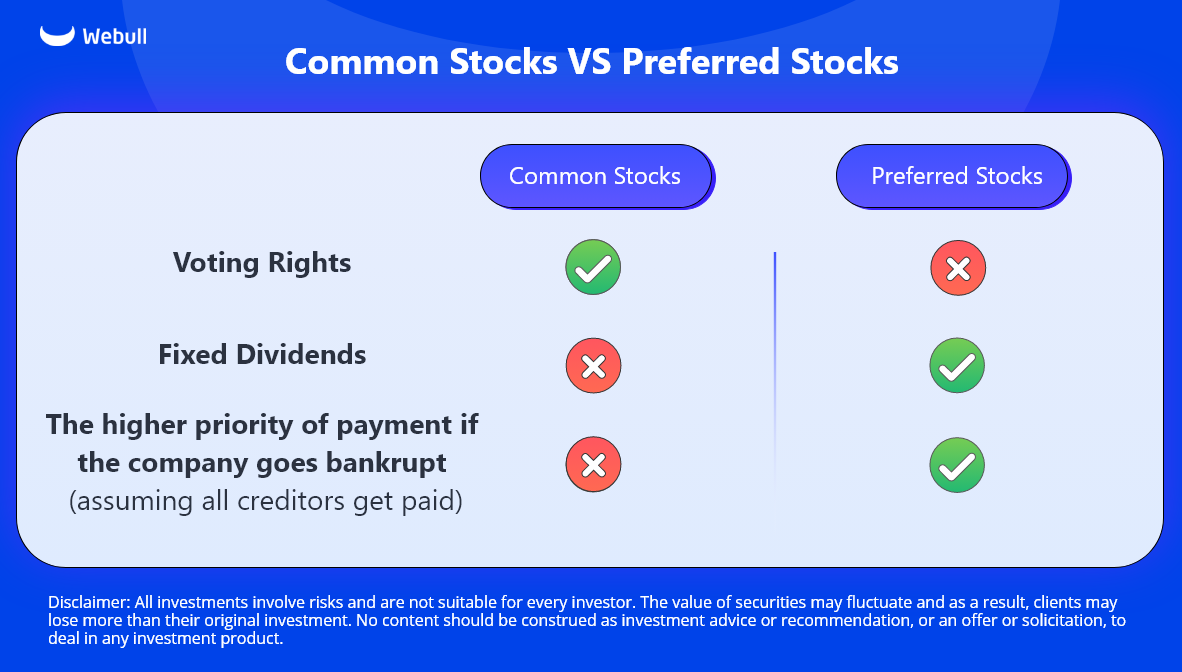
Common shareholders have voting rights for common stocks and receive dividends at the company's discretion. However, even if the company is profiting during the current year, the company doesn't need to declare a dividend distribution to common shareholders.
Preferred shareholders will receive fixed dividends and are entitled to a preferential dividend distribution before common shareholders. Unlike common shareholders, they do not have voting rights but have a superior claim over the company’s assets. If liquidation occurs, preferred shareholders have a higher payment priority than common shareholders behind the company's creditors.
Reasons for Investing in Stocks
People hold or trade stocks for different reasons. These can include but are not limited to:
- Harvesting the capital gains as the price appreciates.
- Receiving dividend distribution from the company's earnings as income.
- Exercising the voting rights to influence the company as an owner.
Risks of Stocks
There is no guarantee that you will make a profit when investing in stocks. Prices constantly fluctuate, creating the risk that can cause investors to lose all of the money invested in the stock market. The two most common and general risks in the stock market are systematic and unsystematic risks.
Systematic risk, also known as market risk or non-diversifiable, refers to the risk affecting the entire market. The systematic risk factors include inflation, interest rates, business cycles, natural disasters, and political turbulence. These factors affect the entire financial market and cannot be avoided through diversification.
Unsystematic risk is the risk that affects a specific sector or a company. It is also known as industry-specific, company-specific, or diversifiable risk.
For example, a drug trial failure is considered unsystematic because it might drop the manufacturer's stock price. However, it might not influence the stock price of retail drug chains.
Webull Malaysia do not support voting rights as shareholders.