
PRACTICE Note 17, otherwise known as PN17, is part of Bursa Malaysia’s Listing Requirements for the Main Market.
Companies that meet certain financial conditions may fall under the PN17 category.
When a listed issuer is classified as PN17, it must comply with the provisions of the Practice Notes.
Under Paragraph 2.1, a listed issuer may fall under the PN17 category if it triggers any one or more of the six prescribed criteria outlined in the Practice Notes.
The key element of PN17 is spelt out under Paragraph 5.0, which states that listed issuers are obligated to regularise their financial condition.
This may or may not involve a change in the listed issuer’s business direction.
In cases where there is a change in business direction, an application must be made to the Securities Commission (SC) for approval within 12 months from the date of the first announcement and complete the regularisation plan within the time frame prescribed by the SC.
For companies not undertaking a significant change in business direction, they must submit a plan to Bursa Malaysia and obtain the regulator’s approval to implement it within 12 months from the date of the first announcement.
Listed issuers are also expected to complete the implementation of the plan within six months approval and up to 12 months for cases involving court proceedings.
Upon implementation of the plan, a listed issuer is expected to record a net profit in two consecutive quarterly results immediately after.
These quarterly results must undergo a limited review by an external auditor before being announced to Bursa Malaysia, as outlined in Paragraph 5.2(c) of PN17.
If an affected listed issuer is unable to record a net profit in two consecutive quarterly results immediately after completing its regularisation plan, there is a risk that the issuer will continue to be classified as PN17.
In such cases, Bursa Malaysia may suspend trading of the company’s shares and/or remove the company from the official list of Bursa Securities.
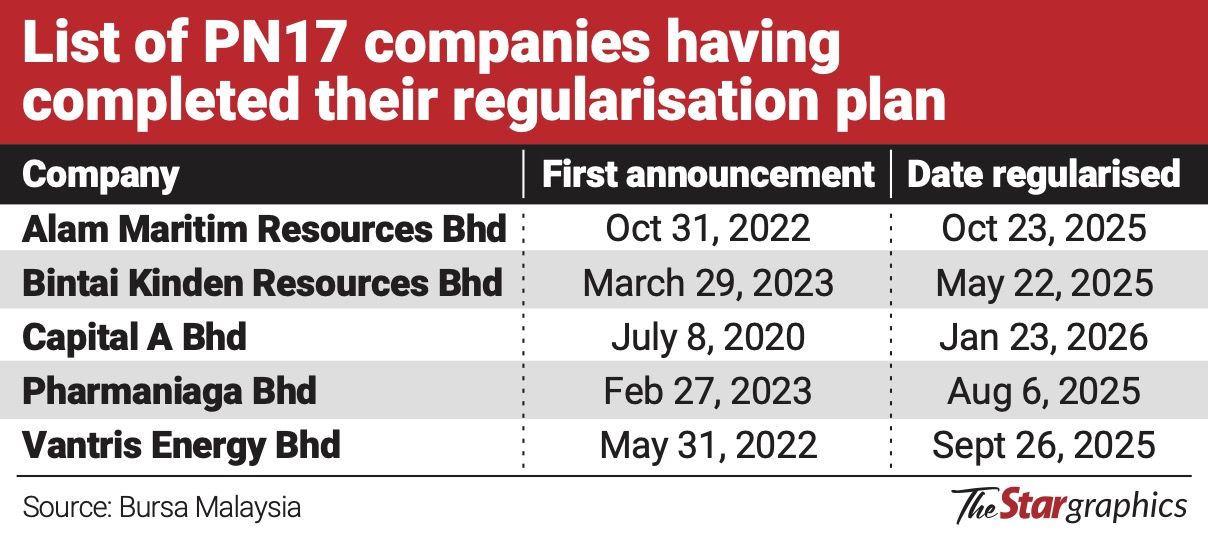
Based on the latest filings as of Feb 5, 2026, there are presently 15 Main Market-listed companies that fall under the PN17 category, all at various stages of their regularisation plans.
Of these 15 companies:
> Seven have yet to submit their regularisation plan,
> Five have implemented their respective plans and are now pending compliance with Paragraph 5.2(c) of PN17,
> One has submitted its regularisation plan and is awaiting regulator approval, and
> Two are in the middle of implementing their plans, having received consent from the regulators.
In terms of tenure, the longest-serving PN17 company that has yet to submit its regularisation plan is MMM Group Bhd, first classified as an affected issuer in October 2019.
The most recent company on the PN17 list is Ho Hup Construction Co Bhd, which made its first announcement as an affected listed issuer in April 2025.
Exiting the PN17 category
Exiting PN17 is a long journey, as companies not only need to implement their regularisation plans, but must also ensure compliance with Paragraph 5.2(c) of the Practice Note.
Based on the table, it can be summarised that the regularisation process takes time.
Even among the current list of companies that have implemented their plans, it has taken, on average, more than three years to complete.
Compliance with Paragraph 5.2(c) only begins after the regularisation plan is carried out, since it requires two consecutive quarterly net profits.
For example, Pharmaniaga Bhd, which has a December financial year-end and implemented its regularisation plan on Aug 6, 2025, will have its compliance with Paragraph 5.2(c) based on its third quarter (3Q) and 4Q results.
So far, the company has announced a net profit for one quarter, and the next quarterly report, expected this month, will be crucial for the company to meet the requirement.
Assuming it meets the threshold, Pharmaniaga will finally exit its PN17 status just over six months after implementing its plan. In contrast, Alam Maritim Resources Bhd has yet to exit the PN17 category, as it has not recorded two consecutive profitable quarters.
The next two reporting periods will determine its path toward declassification as an affected listed issuer. For Bintai Kinden Corp Bhd, while it has reported two quarterly results since implementing its regularisation plan, unfortunately, only the most recent quarter ended Sept 30, 2025, was profitable.
Vantris and Capital A
All eyes are also on Vantris Energy Bhd (VEB) and Capital A Bhd. In the case of VEB, its first reported quarterly period after completing its regularisation plan, ended October 2025, posted a whopping net profit of RM4.27bil, largely due to a gain of RM4.46bil from debt forgiveness following the plan’s completion.
Whether this is considered as net profit under Paragraph 5.2(c) is debatable, as debt forgiveness is one-off and non-recurring in nature.
In the case of Capital A, compliance with Paragraph 5.2(c) requires two consecutive profitable quarters after completing its regularisation plan.
The upcoming quarterly results ending March 31, 2026 and June 30, 2026 will be crucial to demonstrate a return to profitability.
Reporting for these quarters is expected in May and August 2026.
In conclusion, while PN17 is a painful journey for all stakeholders, successfully exiting it is equally crucial for listed issuers.
Companies must prove that their regularisation plans are effective by returning to sustained profitability. For shareholders, it would be a double whammy if a company, having exited the PN17 category after implementing its plan, falls back into the classification due to factors triggering any of the prescribed criteria under the Practice Note.